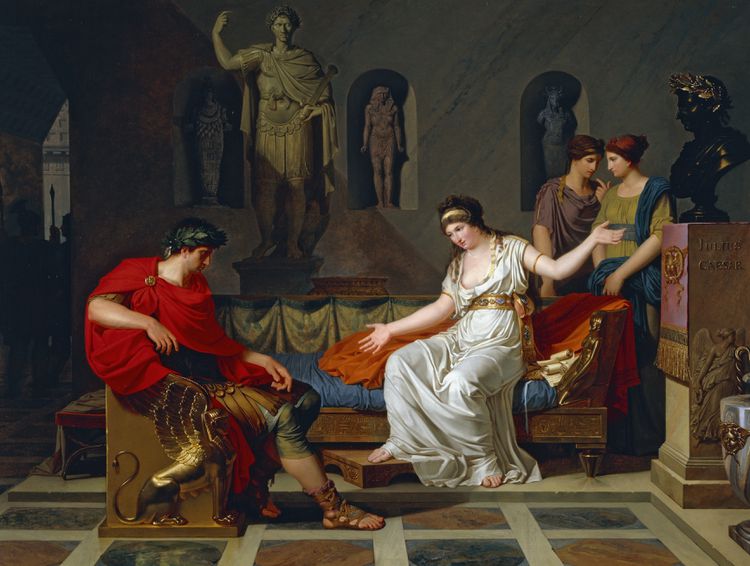
History often remembers Cleopatra as a woman of beauty and mystery. Movies show her reclining on golden couches, surrounded by servants and luxury, charming powerful Roman men with her presence. But this image raises an important question: was Cleopatra simply a seductive queen, or was she something far more powerful—a politician and strategist fighting to protect her kingdom?
Cleopatra VII was born in 69 BC into the Ptolemaic dynasty, a Greek royal family that had ruled Egypt since the time of Alexander the Great. By the time she became queen in 51 BC, Egypt was wealthy but politically fragile. Rome had become the dominant power in the Mediterranean, and many kingdoms were slowly falling under its control. Cleopatra understood that survival would require more than royal privilege. It would require intelligence, diplomacy, and careful political alliances.
Unlike many rulers of the ancient world, Cleopatra was known for her education. Ancient writers report that she spoke several languages and studied philosophy, mathematics, and science. She was also the first ruler of her dynasty to learn the Egyptian language and present herself as a true Egyptian pharaoh rather than just a Greek monarch. This helped her connect with her people and strengthen her authority. For Cleopatra, ruling was not simply about power—it was about strategy. As the Romans might say, scientia potentia est—knowledge is power.
Cleopatra’s reign began during a crisis. According to Egyptian tradition, she ruled jointly with her younger brother Ptolemy XIII. But palace politics quickly turned dangerous. Rival advisers pushed Cleopatra out of power, and she was forced to flee Alexandria. Many rulers might have accepted defeat, but Cleopatra saw an opportunity.
At that exact moment, Julius Caesar arrived in Egypt while pursuing his enemy Pompey during a Roman civil war. Cleopatra knew that Caesar’s support could restore her throne. According to the ancient historian Plutarch, Cleopatra arranged a secret meeting with him by being smuggled into the palace wrapped in a carpet or bedding sack. Whether the dramatic detail is true or not, the moment shows Cleopatra’s boldness. She was willing to take risks if it meant regaining power.
Her meeting with Caesar worked. The two formed an alliance that allowed Cleopatra to defeat her rivals and reclaim the throne. Later Roman writers focused heavily on their romance, but the relationship was also deeply political. Cleopatra needed Roman military support, and Caesar needed Egypt’s wealth and stability. In Roman terms, their partnership reflected do ut des—“I give so that you may give.”
After Caesar’s assassination in 44 BC, Cleopatra again faced uncertainty. Rome was thrown into chaos as different leaders fought for control of the Republic. One of those leaders was Mark Antony, a powerful general and ally of Caesar. Cleopatra aligned herself with Antony, forming both a political and personal partnership.
Together, Antony and Cleopatra attempted to build a powerful eastern alliance that could rival the growing power of Octavian, Caesar’s adopted heir. However, Octavian understood the importance of public opinion. He launched a massive propaganda campaign in Rome, portraying Cleopatra as a dangerous foreign queen who had seduced Antony and turned him against Rome.
This image proved powerful. Roman poets and historians repeated the story of Cleopatra as a manipulative seductress. Yet this narrative was politically convenient. By portraying Cleopatra as a threat, Octavian could justify war against her and Antony. In reality, Cleopatra was acting like many rulers of the ancient world—forming alliances, protecting her throne, and defending her kingdom.
The final chapter came in 31 BC at the Battle of Actium. Octavian’s fleet defeated the combined forces of Antony and Cleopatra. Within a year, both leaders were dead, and Egypt became a Roman province. Cleopatra’s long fight to preserve Egyptian independence had come to an end.
Yet her story did not end there. For centuries, Roman writers shaped Cleopatra’s legacy as a woman whose beauty controlled powerful men. However, modern historians increasingly recognize her as something far more impressive: a capable ruler navigating one of the most dangerous political environments in history.
Cleopatra ruled during the final collapse of the Roman Republic, a time when even Roman leaders struggled to survive. That she managed to hold power for two decades, maintain Egypt’s wealth, and remain a central figure in Mediterranean politics speaks to her remarkable ability.
In the end, Cleopatra was not simply a seductress. She was a strategist, a diplomat, and a queen determined to protect her kingdom. As the Romans said, fortuna audaces iuvat—fortune favors the bold. And Cleopatra, without question, was bold.
Bibliography
Goldsworthy, Adrian. Antony and Cleopatra. Yale University Press, 2010.
Roller, Duane W. Cleopatra: A Biography. Oxford University Press, 2010.
Plutarch. Life of Antony. Translated in Parallel Lives. Penguin Classics.