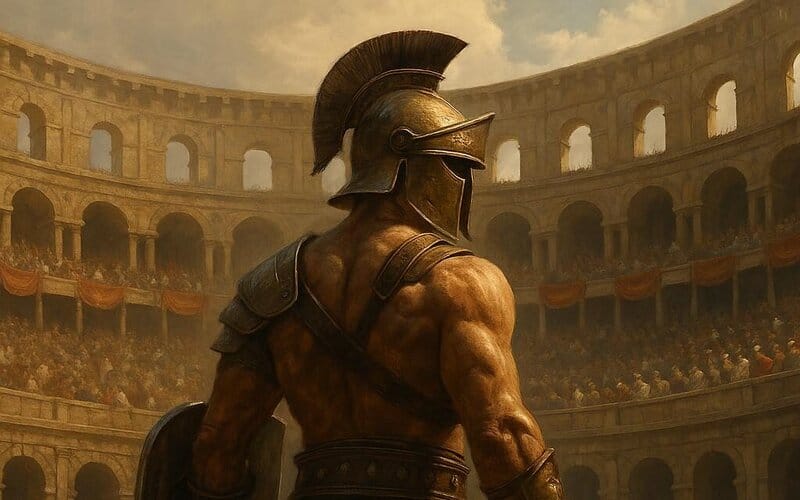
Imagine the roar of fifty thousand voices rising under the Roman sun. Dust hangs in the air. Vendors shout. Trumpets sound. All eyes turn toward the arena floor as two figures step forward — armored, trained, and ready. For Romans, a day at the games was not just entertainment; it was headline news, the kind of story that would have filled the ancient Acta Diurna, Rome’s daily public record.
The gladiatorial games, known as munera, began as solemn rituals honoring the dead, but by the height of the Roman Empire they had become grand public spectacles. Emperors and politicians sponsored lavish events to win public favor, embodying the famous phrase panem et circenses — “bread and circuses.” The arena was where politics, performance, and public emotion met.
Who were the gladiators? Some were prisoners of war or enslaved people, but others were volunteers called auctorati, men who signed contracts to fight in exchange for pay and the possibility of fame. To modern readers, this might sound shocking, but in Rome, the promise of gloria — public recognition — could outweigh the risks. Graffiti in Pompeii praises certain fighters like celebrities, with fans declaring their admiration in bold letters on city walls.
Before stepping into the arena, gladiators trained in rigorous schools known as ludi. Here they practiced with wooden weapons, followed strict diets, and prepared both physically and mentally for combat. Each type of gladiator had a distinctive style. The heavily armored murmillo faced opponents like the agile retiarius, who fought with a net and trident — a matchup designed to keep spectators on edge.
As the crowd watched, every movement carried meaning. Combat was not always a fight to the death. A defeated gladiator could appeal for mercy through missio, raising a finger to signal surrender. The decision often rested with the sponsor of the games, influenced by the mood of the crowd. Victory brought cheers, prizes, and sometimes lasting fame.
Why did Romans love the games so deeply? For many, the arena was a living display of Roman values. Courage, endurance, and discipline — the essence of virtus — unfolded before their eyes. The spectacles also reinforced social order, reminding spectators of the power of the state and the fragility of life.
Yet not everyone cheered. The philosopher Seneca wrote critically of the games, warning that repeated exposure to violence could dull moral judgment. His observations, recorded in his letters, sound strikingly modern — a reminder that debates over violent entertainment are as old as the arena itself.
On festival days, the city buzzed with anticipation. Crowds flowed toward amphitheaters like the Colosseum, carrying food, gossip, and excitement. The games created a shared civic experience, bringing together people from different classes in a single, dramatic space. For a few hours, Rome watched the same story unfold — a narrative of risk, skill, and spectacle.
Looking back, gladiators stand at the intersection of admiration and exploitation. They were heroes to some, victims to others, and symbols of a society captivated by public display. Their stories, preserved in texts, inscriptions, and ruins, still echo today, reminding us that entertainment has always reflected deeper cultural values.
If the ancient Acta Diurna had reported on a day at the games, it might have read like a vivid chronicle of triumph and tragedy — proof that in Rome, the arena was more than a stage. It was a mirror of society itself.
Bibliography
Futrell, Alison. The Roman Games: A Sourcebook. Blackwell, 2006.
Hopkins, Keith, and Mary Beard. The Colosseum. Harvard University Press, 2005.
Juvenal. Satires, Book 10.
Kyle, Donald G. Spectacles of Death in Ancient Rome. Routledge, 1998.
Seneca. Epistulae Morales ad Lucilium (Letters), Letter 7.
Tacitus. Annals.