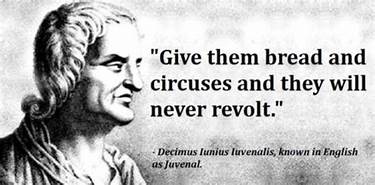
“Panem et circenses.” Bread and circuses. This famous phrase originates from Juvenal, a Roman satirist who was not particularly impressed with the direction Rome was headed (Juvenal, Satires 10.77–81). He felt the Roman people had traded their voice in the Republic for a full stomach and free entertainment (Juvenal, Satires 10). Nobody asked questions, nobody cared who held power or how. As long as the Colosseum roared, the Senate held the power to do what it wanted (Hopkins 1983). Sound familiar?
In the Roman Republic and well into the Empire, public distraction was not a byproduct of governance; it was the strategy (Flaig 2000). Emperors and consuls leaned heavily into spectacle to win favor with the population (Suetonius, Lives of the Caesars; Cassius Dio, Roman History). Gladiator fights, chariot races in the Circus Maximus, and massive festivals all provided free entertainment (Hopkins 1983).
Now, fast forward a couple of thousand years. The world looks different, but the underlying formula remains the same. We’ve just upgraded the circus. The grain still flows through a food system built on fast, cheap calories (Garnsey 1988). Meanwhile, the modern arena is digital. Streaming services compete with 24/7 news cycles, social media drama, and billion-dollar sports franchises. Political topics have turned into flashy headlines, soundbites, and events designed to entertain rather than inform.
Election season is a perfect example. Instead of policy debates, we get theater. Carefully choreographed speeches, camera-friendly rivalries, and applause lines crafted for viral clips. Complex issues, such as housing, climate, and infrastructure, are crammed into slogans or tossed aside in favor of culture wars. Real governance occurs behind the curtain. In front, it’s just another show for the crowd.
But this isn’t just about spectacle, it’s about control. Rome understood that well (Tacitus, Annals). The more occupied people are, the less likely they are to resist. The more they’re entertained, the more they’ll tolerate. It worked for Rome for a long time, until it didn’t. Because eventually the grain supply ran dry (Garnsey 1988). The entertainment lost its luster, and it turned out that the system had been crumbling the whole time.
We’re not ancient Rome, but the parallels are hard to ignore. The attention economy thrives on distraction. Our digital forums aren’t too different from the old ones: loud, chaotic, and full of competing agendas. The modern “bread” is not just physical either. It’s convenience, ease, endless content, and consumption. All carefully organized to keep us scrolling, watching, and buying, not necessarily thinking.
That’s the scary part. Because while we’re busy being entertained, things are happening. Real decisions are being made, quietly and without fanfare. And unlike in Rome, there’s no forum where we can gather and demand accountability, not when everyone’s glued to their own private Colosseum.
Juvenal wasn’t wrong. Bread and circuses are powerful. They work. They always have. The question is whether we notice when they’re being used on us. And if we do, whether we care enough to turn off the circus and ask what is really going on in the Senate.
Bibliography
Cassius Dio. Roman History. Translated by Earnest Cary. Loeb Classical Library, Harvard University Press.
Flaig, Egon. Ritualized Politics: The Roman Games and Political Culture. Brill, 2000.
Garnsey, Peter. Famine and Food Supply in the Graeco-Roman World. Cambridge University Press, 1988.
Hopkins, Keith. Death and Renewal: Sociological Studies in Roman History. Cambridge University Press, 1983.
Juvenal. Satires. Translated by Susanna Morton Braund. Loeb Classical Library, Harvard University Press.
Suetonius. The Twelve Caesars. Translated by Robert Graves. Penguin Classics.
Tacitus. Annals. Translated by Alfred John Church and William Jackson Brodribb.