If there’s one class that will spend quite some time on people’s bathing habits, it's a Roman history class.
The Roman baths, known as thermae, were not just places for bathing and relaxation, but also for exercise and socializing. These extensive spaces, adorned with fine mosaic floors and marble walls, were open to all and served as bustling community hubs where people from all walks of life could come together (Fagan, 1999).
The typical parts of thermae included:
apodyterium: changing rooms
palaestrae: exercise rooms
natatio: open-air swimming pool
laconica and sudatoria: heated dry and wet steam rooms
calidarium: hot room, heated with a hot water pool
tepidarium: warm room, indirectly heated with a tepid pool
frigidarium: cool room, unheated with a cold bath, the heart of the complex (Yegül, 1992)
Among the famous baths were the Baths of Titus (AD 81) and the Baths of Caracalla (AD 217). The latter, completed by Emperor Caracalla in 217, was Rome’s most luxurious. Its ruins, the most extensive of any baths, stand as a testament to the grandeur of the Roman Empire (Fagan, 1999). For Caracalla, often portrayed as a tyrant, the ruins are his glowing accomplishment. I’m not sure how he would feel about that.
An average day of a Roman at the baths would vary, but perhaps follow something like this: They first go through the apodyterium, where a slave would watch their belongings as they enjoyed (Seneca, Epistulae Morales 86). While some baths were separated, most were mixed — a concept associated with the moral decline of the Empire as it was criticized by Cato the Elder and later moralists (Yegül, 1992). Next, they would be slathered in oil before exercising at the palaestrae. Then they would enter the calidarium and the steam room. In the steam rooms (laconia and sudatoria), their sweat and oil would be scraped off with a strigil (strigilis) (Fagan, 1999). Finally, they would cool off in the tepidariumbefore ending in the frigidarium.
Essentially, a Roman citizen would go, sweat, and wash off in descending water temperatures — all while catching up with their friends.
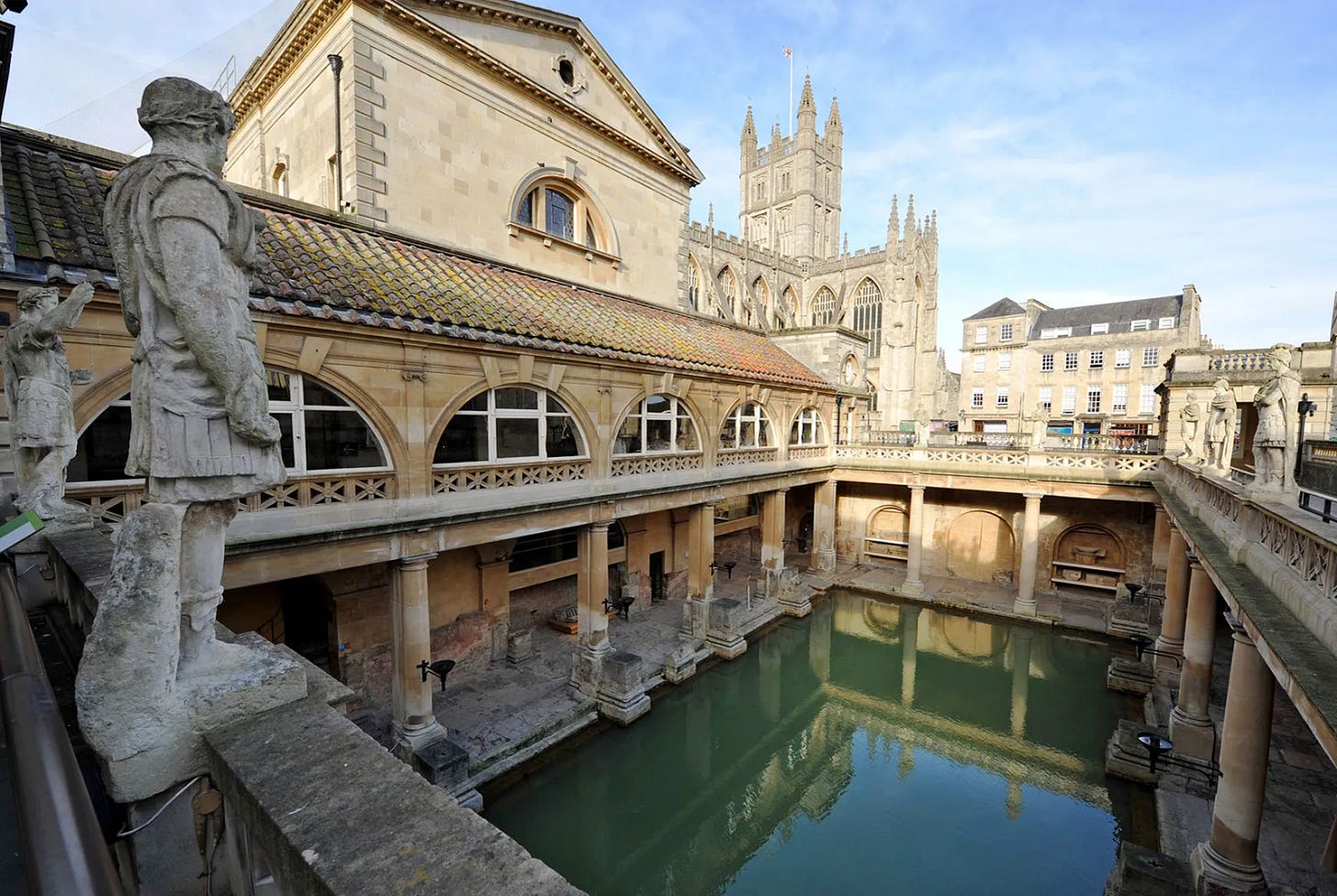
Another well-preserved thermae is the Roman Baths in the appropriately named city of Bath, England. It was constructed between 60 and 70 AD when Rome occupied Britain and was used until the end of Roman rule in the 5th century AD. The temple to the goddess Sulis Minerva was connected to the baths, an amalgamation of the local Celtic deity Sulis of healing and the Roman goddess Minerva of wisdom (Cunliffe, 1984). The city around the Roman Baths was known as Aquae Sulis, and the Baths can still be visited today.
Thermae, once a defining feature of everyday life in Rome, began to decline in usage after the fall of the Roman Empire in the 5th century CE, dissipating from the rest of Europe (Fagan, 1999). The concept of public, collective bathing, once integral to Roman cities, now seems foreign. However, it remains a fixation in modern history classes, a reminder of a bygone era.
I would not want to partake in going to the thermae — all that sweat and steam sounds putrid, and the perfect breeding ground for disease. Marcus Aurelius and other writers expressed concerns about the baths’ dirt and crowding (Meditations8.24). Going for a swim in the frigidarium would not be all unpleasant, but thank goodness for chlorine today! Now, when I take a steaming hot shower, I pretend I’m in the calidarium, gossiping with my fellow citizens about the latest toga trend. Seriously, things like this make me grateful I was born in this age.
Bibliography
Cunliffe, Barry. The Roman Baths at Bath. London: Routledge, 1984.
Fagan, Garrett G. Bathing in Public in the Roman World. Ann Arbor: University of Michigan Press, 1999.
Seneca. Epistulae Morales ad Lucilium. Translated editions.
Marcus Aurelius. Meditations. Translated editions.
Yegül, Fikret K. Baths and Bathing in Classical Antiquity. Cambridge, MA: MIT Press, 1992.